Google Chromebook: Is It For Me?

Welcome to the first of a recurring series here on my Making Technology Simpler blog: “Is It For Me?” I’ll explain a product or technology, then help you figure out if it meets your needs. This week’s subject is the Google Chromebook.
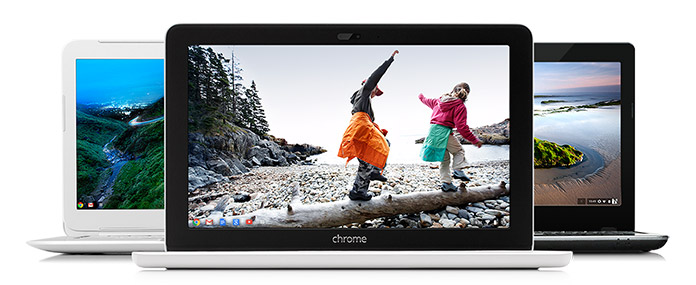
Chromebook laptops
Google Chromebooks (Photo courtesy of google.com)

Google Chromebooks are a series of inexpensive laptops with great battery life, strong integration with Google, and little maintenance needed.

Chromebooks use an operating system created by Google called Chrome OS…the whole operating system is basically the Chrome Internet browser that many people use on Windows and Mac computers. The computer hardware is made by companies like Acer and HP.

Pros

Here’s another thing that makes Chromebooks unique among laptops: the whole operating system is designed to be used with Internet access, and the hard drive in the computer is tiny.

Google intended for these computers to be used in conjunction with Google’s cloud storage, so photos will need to be stored in Google+ and documents stored in Google Drive. (I wrote about cloud storage here.) With everything stored in the cloud, there’s no need for a big hard drive. The benefit of this is the computer will boot up very quickly.

This reliance on cloud storage has a couple other ramifications. On the positive side, no data backups are needed, since almost everything is in Google’s cloud. And once the computer needs to be replaced, you can sign into your next Chromebook with your Google account, and all your emails, documents, etc. will be available immediately. No file transferring necessary.

Cons

On the flip side, you will be limited in what your Chromebook can do without Internet access. You can do some document creation, for example, and the document will save to Google Drive when you connect to the Internet again. Internet access is becoming more widespread, however, and some Chromebooks will allow you to also connect to a 4G network through a carrier like T-Mobile.

Because almost everything you do on a Chromebook involves Internet access, the speed of the computer itself will be heavily influenced by the speed of your Internet connection. If you regularly use a slow connection, be prepared to pay for faster speeds to really enjoy a speedy Chromebook experience.

The other main limitation of Chromebooks is that you can’t install PC or Mac programs on it. So if you really need the full version of Microsoft Office or some specialized accounting program for your work, a Chromebook isn’t for you (unless it’s as a secondary computer). You’re limited to using Google’s apps and others available through the Chrome web store.

Ease of use

Chromebooks are low maintenance devices, partly because they update automatically and Google says they’re very secure and have no need for antivirus software.

Setup is also easy, to the degree that you’re already part of Google’s services. If you already use Google for email, documents, photos, and music, your new Chromebook will be ready to go as soon as you open it and sign in with your Google account.

If you use iTunes for your music and store documents or photos on your current computer, you’ll want to transfer all of it to Google’s appropriate online service before you make the switch to a Chromebook. (And if you have an iPhone, iPad, or iPod, know that they won’t sync with music on your Chromebook.)

Remember, third-party apps like iTunes or Microsoft Office can’t be installed on a Chromebook. So you’ll need to use a Google service or a third-party service that can be accessed online (such as Pandora for music streaming or the online version of Microsoft Office).

Is it for me?

A Chromebook might be great for you, if:

  • You use Google for all of your email, documents, photos, media, and calendar (or are willing to move all those things to Google)
  • You have Internet access almost all the time
  • You need a very portable computer with a battery that lasts all day
  • A low up-front cost is important to you

You should probably stay away from a Chromebook, if:

  • You need an application that only runs on a PC or Mac, like Adobe Creative Cloud, Microsoft Office, or iTunes
  • You prefer to store your documents, photos, or media locally (i.e. on your computer’s hard drive)
  • Your computer needs to handle intense tasks, like games or video editing

Have you seen or heard about another device or technology that’s made you ask, “Is it for me?” Let me know below, and I’ll write about it soon.

-Paul

Go back

Your message has been sent

Warning
Warning
Warning
Warning

Warning.


Do you need that much smartphone data?

Smartphone in use
How much data does your smartphone actually need?

If you have a smartphone, you probably know that your data plan is a big chunk of your monthly bill. But when was the last time you checked how much data you actually use? Are you paying for more data than you need?

What is data usage?

Data usage on a mobile device (most often a smartphone or tablet) is simply all information that is sent from or received by the device. (The exception is phone calls and text messages, which are counted separately from data.)

This includes text (emails, websites, etc.), audio (downloading songs, listening to online radio stations, etc.), video (watching Netflix, downloading a movie, etc.), and other uses (such as GPS navigation or downloading and using certain apps).

Here’s a good way to check what activities use data: put your phone in airplane mode. That way it can’t access any data at all. Certain functions will still work, like viewing photos you’ve taken on your phone. If a certain app or activity won’t work on airplane mode, then it needs access to data to work.

How much data do I use?

Now that you have an idea of what activities use data on your phone, you’ll want to find out how much data you’ve actually used in the past. Your monthly bill may show that, or you may have to log in to your phone carrier’s website.

Remember that many phone plans these days have begun counting shared data among all the devices on the plan. So if you have family members with smartphones, their data will also be counted toward the monthly limit.[1]

If you’re wanting to instead get an idea of what your data plan could be, or you want to know what activities use more data, check out one of these data calculators from the four major carriers. Pay attention to whether you are inputting monthly or daily usage for each site.

NOTE: data usage is the same regardless of which carrier you use,[2] so you don’t have to just use the calculator from your carrier. Feel free to try multiple ones; one might be more helpful than the others.

How can I limit my data usage?

If you’re interested in using less mobile data, I’ve got a couple of tips for you.

Remember that different activities use very different amounts of data (as shown by the data calculators above). Downloading mainly text, such as emails, uses a tiny amount of data. You could check email all day long and not come close to your limit.

Sending/receiving photos (such as uploading a photo to Facebook or sending as an attachment) uses more data. Streaming[3] audio uses still more, and streaming video uses the most data of all. This doesn’t mean you can’t enjoy those activities, but it helps to know the next tip.

Use Wi-Fi when possible. Data that your phone uses when connected to a Wi-Fi network (such as in your home) does NOT count against your data limit. So if you’re at home and your phone is connected to your home Wi-Fi network, stream all the music you want and download app updates at the same time; none of it will count against your total.

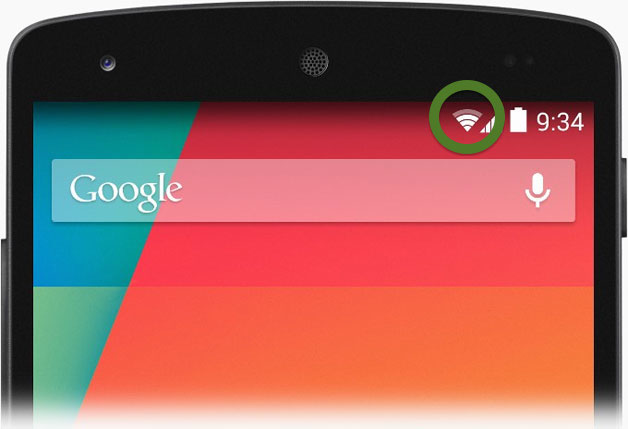
You will want to go into your phone’s settings and make sure that your phone is set to automatically connect to Wi-Fi networks it has previously used.[4] Also, check the status bar at the top of the screen to make sure that you see the Wi-Fi symbol before you start data-heavy activities. Below you can see it on Android and iPhone, marked with a green circle.

Android Wi-Fi symbol
Android phone with Wi-Fi connected (Photo courtesy of androidiani.com)
iPhone Wi-Fi symbols
iOS 6 (left) and iOS 7 (right) with Wi-Fi connected (Photo courtesy of extreme tech.com)

Restrict apps’ access to cellular data. When you’re not connected to a Wi-Fi network, your data usage is considered cellular data, and counts toward your limit. You can restrict your phone from using certain cellular data.

Apple has made this very easy starting with iOS 7. You can tell your iPhone or just particular apps to only use data when connected to Wi-Fi. Apple has a customer support page explaining this.

As far as I’m aware, Android only allows you to limit data used in the background (explained here). This prevents an app to use mobile data unless you actually open it. The newest Android version also has nice visual charts of data usage.

Taking action

Now that you know data isn’t counted against you when you’re connected to Wi-Fi, are there changes you would make when filling out the data calculators above? If you save your data-intensive activities for when you’re connected to Wi-Fi, you may be able to use far less cellular data than you first thought. Maybe you can even downgrade to a less expensive data plan!

————————————-

Do you enjoy reading this blog? If so, I’d love to hear from you! (If you’ve read this far but don’t enjoy it, I’d be glad to hear your thoughts, too.)

What topics do you want to learn about?

Go back

Your message has been sent

Warning
Warning
Warning
Warning

Warning.

1 – Your total may be counted in gigabytes (GB), and lowest data tier from most providers is about 1GB. If your total shows up in megabytes (MB), remember that 1,024 MB equals 1 GB.
2 – T-Mobile recently announced that their customers can stream music through certain apps without affecting their data usage. That’s the only situation I see where data usage would be counted differently among the carriers.
3 – Streaming means watching or listening to something in real time, such as music on Pandora or video on Netflix or YouTube. The opposite would be downloading the audio or video file to your device, and then watching it. Both options use data, but more and more often people are consuming music, movies, etc. on-the-go by streaming them rather than downloading them.
4 – Keep in mind that you shouldn’t do any sensitive activity (such as online banking or sending confidential information) unless you are on a Wi-Fi network with a secure log in and that you trust. Not McDonald’s free Wi-Fi!